Chasing Dreams Across the Sky or Debt as Punishment: A Record of the Fragility of “Money Hunters” on the Global Battlefield
Read 0
Chasing dreams in a land of conflict with “Israeli money hunters”
When it comes to migrant workers, most people tend to think of economic opportunities and remittances that can quickly transform a family’s financial status. However, the documentary “Israeli Money Hunters” takes us into a darker and more fragile dimension, through the lives of Thai workers who choose to risk their lives in one of the most conflict-ridden areas in the world.

ภาพจากสารคดี คน จน เมือง ตอน นักล่าเงินอิสราเอล

ภาพจากสารคดี คน จน เมือง ตอน นักล่าเงินอิสราเอล
The cycle of debt: a trap that drives people to leave
The central issue exposed by this documentary is the “debt structure” in rural Thailand. Agricultural work that cannot provide stable income, combined with accumulated household debt passed down through generations, has made “Israel” one of the few options for earning a large sum of money in a short time. The film shows that these workers are not merely fortune seekers, but “burden bearers” forced by the economic system to gamble their futures against risks abroad.
The fragility of individuals on the global battlefield
The documentary portrays the life of “James,” a young worker from Surin, whose life is suddenly thrown into violence in Israel. What stands out is that the film does not focus on action scenes or moments of life-and-death suspense, but rather on the “post-survival” condition—the struggle of returning to face the same unresolved debt, along with physical injuries and emotional scars. This reflects how the state or labor recruitment systems still lack strong protective mechanisms for workers caught in unexpected crises.
When life becomes a commodity in the labor system
The term “money hunter,” used as the title, carries a dual meaning. On one hand, it reflects the ambition of workers striving to earn money to support their families. On the other, it raises questions about a labor system that treats human lives as mere factors of production, sent into high-risk “red zones.” The documentary highlights how Thai workers are often a “vulnerable group,” lacking bargaining power and adequate preparation when confronted with large-scale security crises.

ภาพจากสารคดี คน จน เมือง ตอน นักล่าเงินอิสราเอล
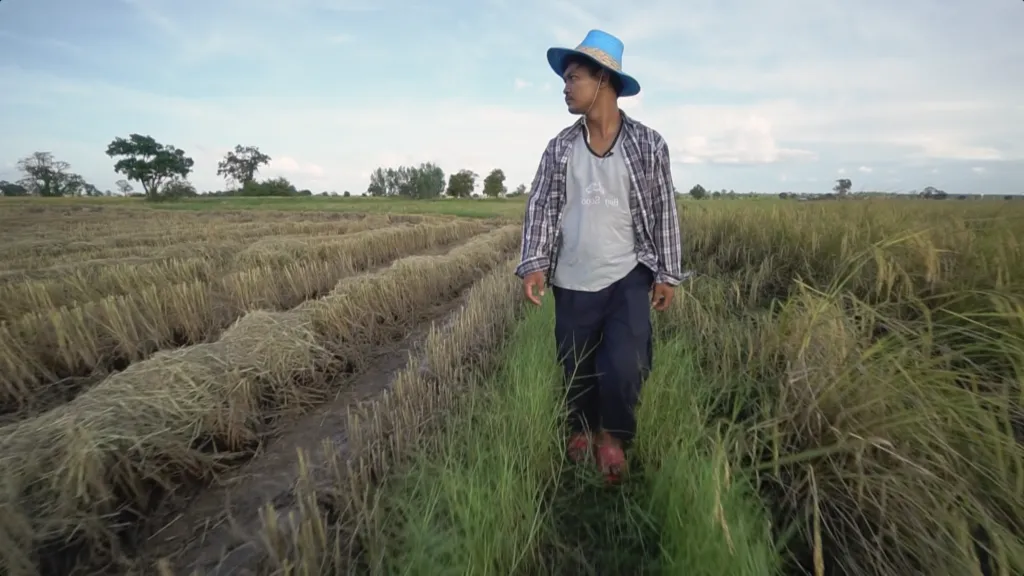
ภาพจากสารคดี คน จน เมือง ตอน นักล่าเงินอิสราเอล
A sociological lens: hope layered with risk
From a structural perspective, this documentary is essentially telling us that “poverty” is the key factor that makes safety a secondary concern. A failing economic system at the grassroots level pushes people to accept the exchange of life for money. This is not a matter of individual recklessness, but a structural problem shaped by the overlap between the global economy and subsistence-level struggles in rural communities.
A new perspective on “money hunters”
Rather than judging the choices of workers, the documentary invites society to question whether we are leaving a certain group trapped in a “hope dilemma.” Working in Israel is not simply an exchange of labor for wages; it is the act of placing one’s dreams into a system of uncertainty that workers have no real control over.
This can perhaps be understood as “the price of poverty.” It is not just a number in a bank account, but a risk shouldered alone by ordinary individuals when larger systems begin to destabilize.

About Author
บอส หลงอินเดีย
นักเขียนผู้รักประวัติศาสตร์และความแตกต่าง ที่หลงใหลการเดินทางและการจดบันทึก เพื่อเข้าใจความคิดผู้คนต่างวัฒนธรรม